
Bakwethu: A journal of Shakespeare studies is the new journal of the Shakespeare Society of Southern Africa (SSOSA). The launch issue, edited by Marguerite de Waal, is now live! Published by Pluto Journals as part of the African Journals Initiative, Bakwethu can be accessed via ScienceOpen. To mark the publication of Bakwethu 1.1, Shakespeare ZA is pleased to share the text of De Waal’s editorial. Scroll down to see an overview of the contents!
It is a pleasure to welcome readers to the first issue of Bakwethu: A Journal of Shakespeare Studies. This marks a moment of renewal for a long-running project. For thirty-seven years, under the title Shakespeare in Southern Africa, this publication served as the scholarly branch of the Shakespeare Society of Southern Africa. Bakwethu is, then, both the same publication that has appeared since 1987 and a genuinely new undertaking. It is an attempt to align the journal’s title with its scope – which often exceeded the regional focus of its previous title – and to seek generative connections in engagements with Shakespeare across contexts. The journal intends to foreground voices, methodologies, and artistic approaches that have historically been underrepresented in Shakespeare studies, especially (but not exclusively) from Africa and the Global South.
Even as the renaming opens up the geographical range of the previous journal, it still reflects the journal’s specific context, continuing to engage with its heritage and the unique history of Shakespeare in South Africa. Readers of the final volume of Shakespeare in Southern Africa will already know that the new title references K.E. (King Edward) Masinga’s 1950s isiZulu radio adaptation of Julius Caesar. Taken from Antony’s funeral oration, which is also the source of the only available recording of Masinga performing his translation, “Bakwethu” calls out to the “countrymen” whom Antony addresses. Meaning both “compatriots” and “my people”, the word reflects the journal’s dual commitment to speak from a local perspective and to invite contributors into a global conversation.
Masinga, in 1941, became the first announcer to read the news in isiZulu. Over the next three decades, he established himself as one of the most popular voices on South African radio, building a broad body of radio-storytelling work of which nine Shakespeare translations were only one part. Masinga’s work has come to be recognised as something far exceeding the limited, government-aligned programming the apartheid broadcasting system had in mind for its African-language listeners. His translations of Shakespeare stand, among his other outputs, as signs of the creative flourishing that worked against the very system that contained them. The previous editorial brought the last version of the journal to a close with brief quotations and a gesture towards the history of Masinga’s work. I am delighted that the new journal can pay more substantial homage to its inspiration by presenting, in this issue, a fully edited version of Masinga’s original radio typescript, commissioned for Bakwethu and published for the first time in these pages. uJulius Caesar closes this issue, edited and presented by Asanda Mzizi, with an introduction offered in both isiZulu and English.
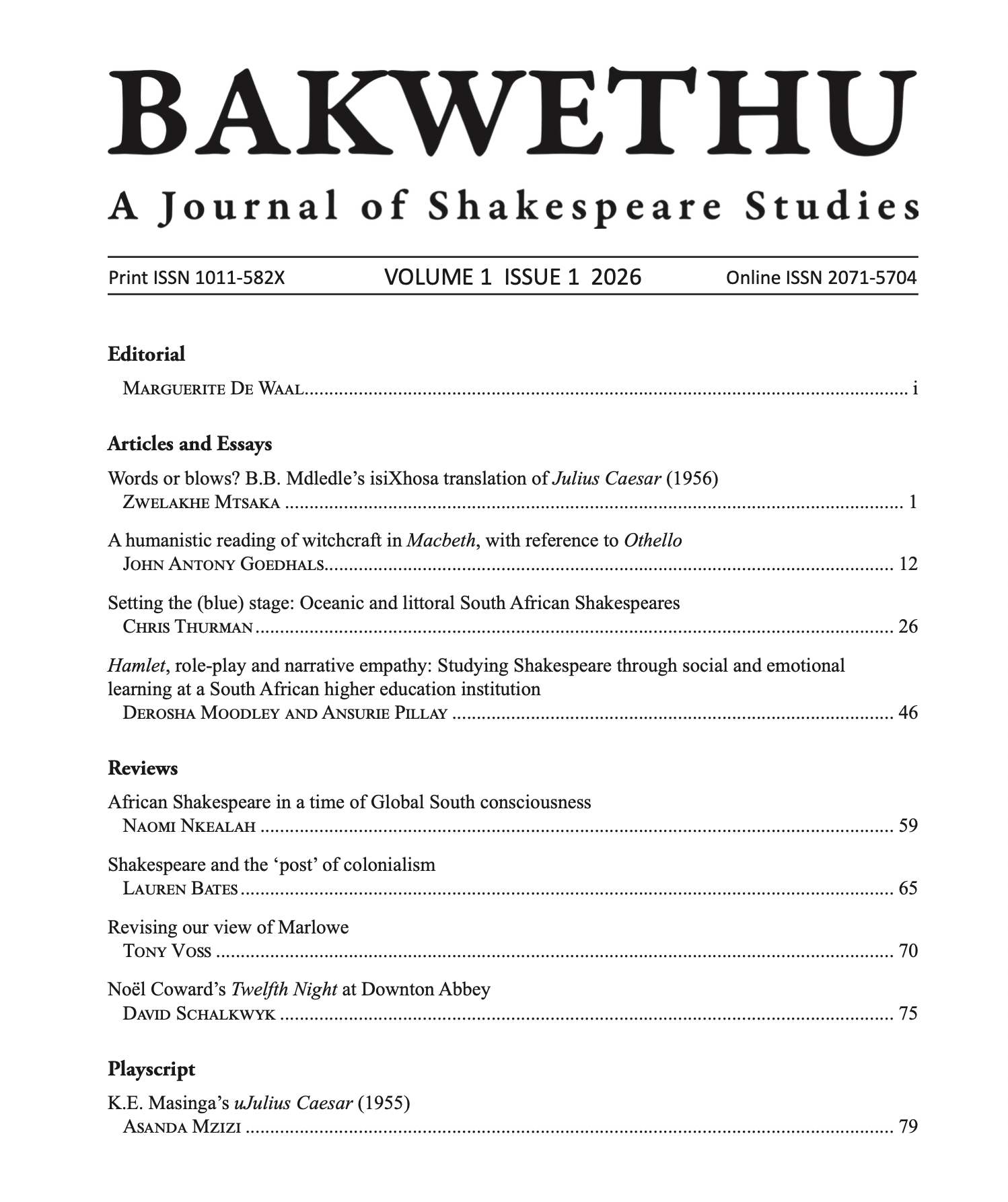
In fact, the issue both closes and opens with Julius Caesar in translation. The first article is Zwelakhe Mtsaka’s “Words or Blows? B.B. Mdledle’s isiXhosa translation of Julius Caesar (1956)”. Mdledle’s uJulius Caesar is an intriguing counterpart to Masinga’s text, published a year after the isiZulu radio version first aired. Both are harder to place politically than their moment of production might suggest. Mdledle had spent two decades criticising the exclusion of black South Africans from government; he would later serve in the cabinet of Kaiser Matanzima, Chief Minister of the “homeland” of Transkei, a position that seemed to compromise his earlier convictions. Mtsaka traces how the plot of Julius Caesar (and the multiple possible interpretations of its resolution) becomes an allegory for the choice facing black political leadership in the 1950s between armed resistance and continued procedural opposition. It is possible, as Mtsaka’s title suggests, that Mdledle’s own thinking aligned with Brutus’s claim that “good words are better than bad strokes” (5.1.27–29). Mtsaka is careful not to offer easy solutions to ambiguities of the translator’s work; like the ambiguities of the text, they remain unresolved, and are spurs to reflection. At either end of this issue, Masinga and Mdledle’s translations demonstrate that Shakespeare, put into isiXhosa or isiZulu at this point in South African history, was never simply carried across languages but was used to contain and express deep political complexity and contestation.
Between these bookends, the remaining contributions stay close to local ground while working through different registers: a reading of witchcraft in Macbeth, considering its implications for teaching; a historical and creative exploration of coastline and climate focused on their potential in performance; and a classroom study of Hamlet investigating what students do with the play when they are asked to inhabit it.
Antony Goedhals’s “A humanistic reading of witchcraft in Macbeth, with reference to Othello” sets aside the metaphysical lens that usually accompanies discussion of Shakespeare’s weird sisters. Taking his lead from Iago’s own description of his manipulations as working “by wit and not by witchcraft” (2.3.362), Goedhals argues that Macbeth explores the linguistic psychology of evil: witchcraft is less prophecy than suggestion, “the planting of word-seeds in receptive minds” (p.12) already prepared to receive them. The argument is connected to the practical question of how such material is taught, and what South African students might gain from considering apparently supernatural problems in more human(istic) terms.
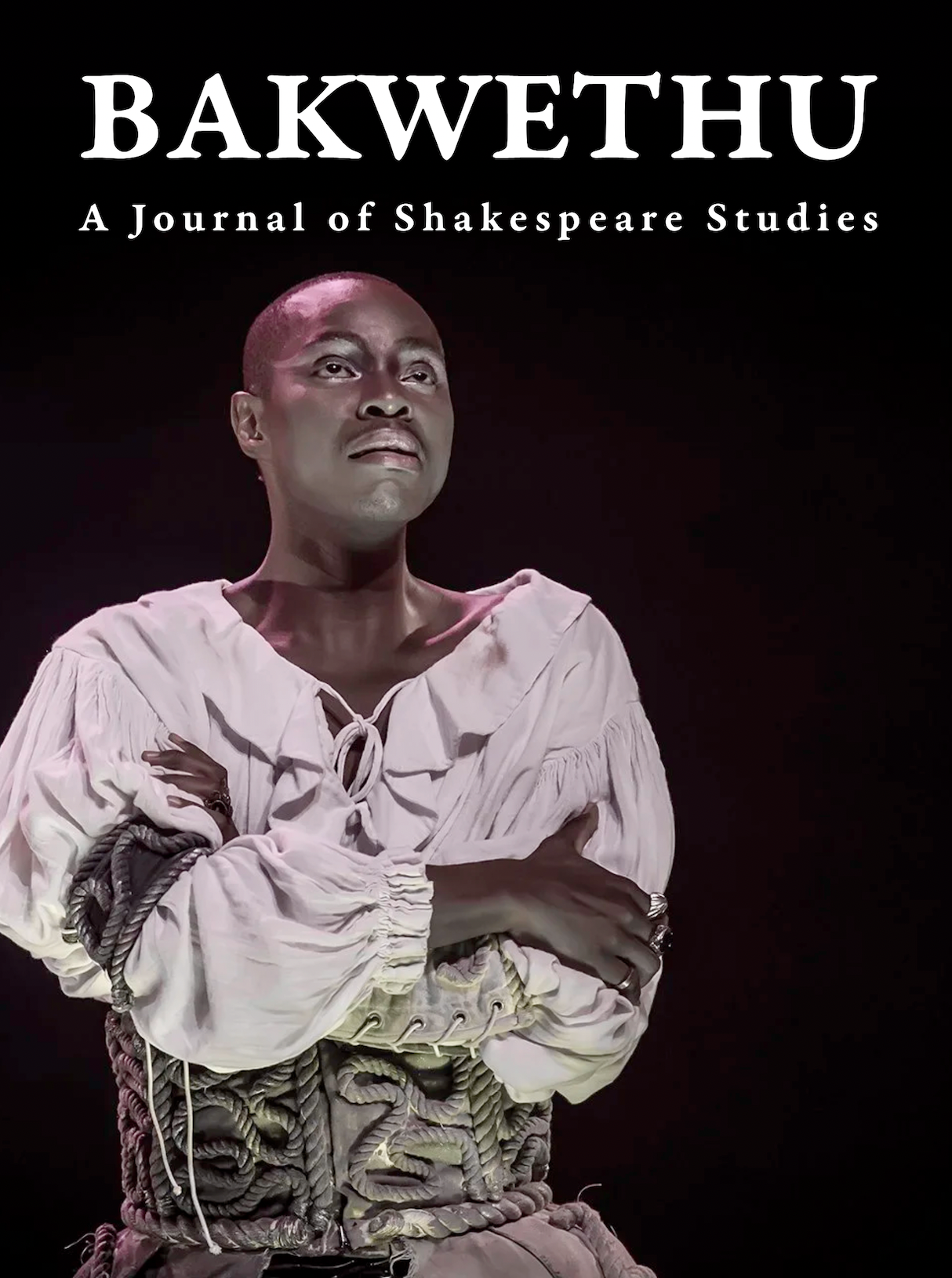
Chris Thurman’s “Setting the (blue) stage: Oceanic and littoral South African Shakespeares” shifts attention from the classroom to the shoreline and provides the context for the issue’s cover image. Depicting Lungile Lallie as Gertrude in a staging of Fred Abrahamse’s touring Hamlet, the image documents the same production Thurman discusses at length: a Hamlet framed as a play performed by the crew of the Red Dragon, following an apocryphal story that Shakespeare was first staged outside of Europe on the deck of this ship off the African coast in 1607. Thurman is unconvinced by the Red Dragon legend as a “short-cut to situating Shakespeare unproblematically in (South) Africa” (p.39), but he is interested in what the production did with it: a stage built over a shallow pool of water, through which Abrahamse’s actors waded, a manifestation of the play’s watery images, from Hamlet’s temptation “toward the flood” (1.4.73) to Ophelia’s drowning. It is against the largely land-bound imagination of post-apartheid Shakespeare, and against the recurring difficulty of post-apartheid stagings of The Tempest that Thurman presents the case for an oceanic approach. The article first tests the concept against two Cape Town sites: the Riverlands precinct, at the site of the 1510 Battle of Salt River, and the Castle of Good Hope. Three further case studies then point toward what such an approach might produce in South Africa: the Insurrections Ensemble’s The Storming, an operetta built from The Tempest and Aimé Césaire’s Une Tempête; Siphokazi Jonas’s award-winning poetry collection Weeping Becomes a River; and A Tempest (for the sea under the city), a 2024 “visual radio play”.
Derosha Moodley and Ansurie Pillay’s “Hamlet, role-play and narrative empathy: Studying Shakespeare through social and emotional learning at a South African higher education institution” closes the research articles with a study of what happens when Hamlet is handed to second-year students as a set of positions to be occupied rather than a text to be interpreted. Drawing on an Action Research cycle of role-play, journalling and autophotography, the authors describe how the exercise built the specific social and emotional learning (SEL) competency of social awareness. Moodley and Pillay address the “colonial residue” (p.46) of teaching Shakespeare in this context, arguing that English literature is a key site for building a decolonial pedagogy. The kind of intervention they propose resists the discipline’s history of enforcing English cultural dominance while still taking seriously what students gain from their encounters with a text.
The four articles trace a chronology of use: Mtsaka shows what was done with Shakespeare in translation historically; Goedhals, and Moodley and Pillay, show what continues to be done with him in South African classrooms, where the weight of the colonial past is neither ignored nor treated as disqualifying; and Thurman shows what has only partly been done so far, sketching a set of coastal and littoral prospects for local performance. Each of these represents continuous activity: Shakespeare is translated, taught, argued with, and waded into, and the chronology ends with a view to future possibilities.
Four reviews complete the issue. Naomi Nkealah reviews African Shakespeare: Subversions, Appropriations, Negotiations (Routledge, 2025), edited by Ifeoluwa Aboluwade, Serena Talento, Pepetual Mforbe Chiangong and Oliver Nyambi. Situated within an emerging body of Global South Shakespeare scholarship, the book is organised around theoretical orientations of decolonisation, translation and feminism, and Nkealah describes it as “direct[ing] our scholarly sensibilities towards an African Shakespeare consciousness that is both provocative and self-reflexive” (p.59). Lauren Bates writes on Shakespeare in the ‘Post’Colonies: Legacies, Cultures and Social Justice (Bloomsbury, 2025), edited by Amrita Dhar and Amrita Sen, approaching the collection candidly as a white South African reader ready for a reckoning with Shakespeare’s colonial uses, and still finding, without the collection softening any of that history, good reasons to keep reading him. Tony Voss reviews Stephen Greenblatt’s Dark Renaissance: The Dangerous Times and Fatal Genius of Shakespeare’s Greatest Rival, Christopher Marlowe (The Bodley Head, 2025), a biography that sets Marlowe’s short career against an Elizabethan London that Greenblatt renders as considerably bleaker and more violent than the period’s reputation usually allows. Finally, David Schalkwyk reviews Steven Stead’s Twelfth Night at the Maynardville Open-Air Theatre (Cape Town, January–March 2026). As a self-described refugee from over-conceptualised Shakespeare in London’s iconic theatres, Schalkwyk found this an “immensely enjoyable” production, describing it as “the best performance of Twelfth Night I have seen” (p.75).
This is a first issue in many senses, but one: the people who have made it possible are largely the same people who made Shakespeare in Southern Africa what it was. My greatest debt is to Chris Thurman, whose work over fifteen years as editor of this journal has built its solid foundations, and whose continued mentorship made the transition to Bakwethu far less daunting than it might have been. I am grateful to the Shakespeare Society of Southern Africa for backing a change that has been some years in the making; to the peer reviewers and editorial advisers whose labour holds up everything published here; and to the contributors themselves for treating a journal with a new name as a safe place to send their work. Two translations of Julius Caesar – Mdledle’s isiXhosa, Masinga’s isiZulu – open and close this volume, with everything else in the issue held between them. If the name we have taken from Masinga means anything, it is that there should be room, in the issues that follow, for a good many more voices to sit alongside his.